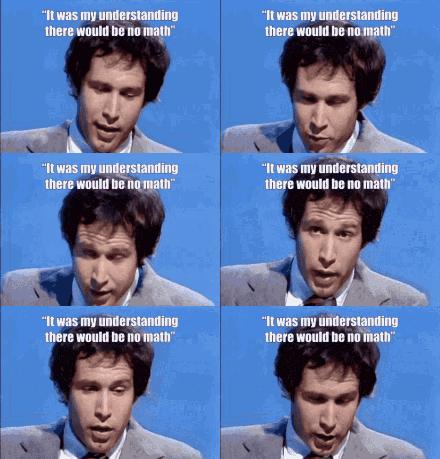
I know you are joking but as somebody who decided it'd be great to be married for 3 years with 3 kids by the time I was 21 instead of a happy go lucky college kid, I am very familiar with what it's like to be broke...flat broke...dead broke...broke like channel 4 broke so I feel ya.
You think I was kidding? Not really, I wasn't. My wife and I were barely able to keep the lights on and food in the fridge for some time, even though we were doing everything "right." If the shit hit the fan and we lost what cushion we've been fortunate enough to develop, I'd rather take a dive and let the battleax make it back home to finish out her days with her family.
I'm going to call my wife a battleax like it's a love term.
I'll report how it goes and how long I'll be on the couch.
I know you are joking but as somebody who decided it'd be great to be married for 3 years with 3 kids by the time I was 21 instead of a happy go lucky college kid, I am very familiar with what it's like to be broke...flat broke...dead broke...broke like channel 4 broke so I feel ya.
You think I was kidding? Not really, I wasn't. My wife and I were barely able to keep the lights on and food in the fridge for some time, even though we were doing everything "right." If the shit hit the fan and we lost what cushion we've been fortunate enough to develop, I'd rather take a dive and let the battleax make it back home to finish out her days with her family.
I'm going to call my wife a battleax like it's a love term.
I'll report how it goes and how long I'll be on the couch.
I know you are joking but as somebody who decided it'd be great to be married for 3 years with 3 kids by the time I was 21 instead of a happy go lucky college kid, I am very familiar with what it's like to be broke...flat broke...dead broke...broke like channel 4 broke so I feel ya.
You think I was kidding? Not really, I wasn't. My wife and I were barely able to keep the lights on and food in the fridge for some time, even though we were doing everything "right." If the shit hit the fan and we lost what cushion we've been fortunate enough to develop, I'd rather take a dive and let the battleax make it back home to finish out her days with her family.
I'm going to call my wife a battleax like it's a love term.
I'll report how it goes and how long I'll be on the couch.
Just tell her to calm down and you'll be fine.
And compare her to her mom, she'll love it...
A good friend will bail you out of jail, but your best friend will be sitting next to you in the cell saying "that was f***ing awesome"
I know you are joking but as somebody who decided it'd be great to be married for 3 years with 3 kids by the time I was 21 instead of a happy go lucky college kid, I am very familiar with what it's like to be broke...flat broke...dead broke...broke like channel 4 broke so I feel ya.
You think I was kidding? Not really, I wasn't. My wife and I were barely able to keep the lights on and food in the fridge for some time, even though we were doing everything "right." If the shit hit the fan and we lost what cushion we've been fortunate enough to develop, I'd rather take a dive and let the battleax make it back home to finish out her days with her family.
I'm going to call my wife a battleax like it's a love term.
I'll report how it goes and how long I'll be on the couch.
Just tell her to calm down and you'll be fine.
And compare her to her mom, she'll love it...
That's not a fair comparison. Her mom would actually listen and calm down.
I know you are joking but as somebody who decided it'd be great to be married for 3 years with 3 kids by the time I was 21 instead of a happy go lucky college kid, I am very familiar with what it's like to be broke...flat broke...dead broke...broke like channel 4 broke so I feel ya.
You think I was kidding? Not really, I wasn't. My wife and I were barely able to keep the lights on and food in the fridge for some time, even though we were doing everything "right." If the shit hit the fan and we lost what cushion we've been fortunate enough to develop, I'd rather take a dive and let the battleax make it back home to finish out her days with her family.
I'm going to call my wife a battleax like it's a love term.
I'll report how it goes and how long I'll be on the couch.
Just tell her to calm down and you'll be fine.
And compare her to her mom, she'll love it...
That's not a fair comparison. Her mom would actually listen and calm down.
The spike in prices under Biden was mitigated by an equal spike in wages. That doesn't appear to be happening now. And anecdotally, the lower working class people I encounter have had enough of Trump. Their lives my not be substantially worse than before, but they sure aren't any better, and the near future prospects appear dim.
I don't know how many times I can keep beating this same drum. Nearly 40% of American adults have zero invested in the market. Nearly 30% have no savings at all, and another 40% on top of that have savings, but less than $1000. One-third of American households don't own their home, and 60% of those who do don't own it free and clear. Fancy metrics don't matter to these people. Economic indicators don't matter to these people. The numbers they see when the fill up their gas tank or buy a loaf of bread, they matter.
-- attachment is not available --
I’m not sure there is much Trump can do about Americans being poor savers and managers of money.
As to @unclemark absurd claim. Real wages have grown more under Trump by any metric. I’m not what hell he thinks he’s talking about.
-- attachment is not available --
While average is going up, it is because high wage earners are rocketing up. From Google AI:
Real average hourly earnings in early 2026 show a "K-shaped" divergence, withhigher-income workers experiencing better wage growth (around 4.0%–4.5% annually) compared to lower-income workers (closer to 1.5%–3.5%). While nominal wages have grown, inflation and high living costs have created a bifurcation, where top earners sustain spending, while middle- and lower-income households face diminishing purchasing power.
Forbes +4
Key Aspects of the K-Shaped Wage Trend
Diverging Fortunes:Data suggests wage growth for the top income quartile has held up better, declining less than that of the lowest-income quartile.
Real Wage Decline:While nominal wages for the bottom 10% surged in 2020-2022, recent inflationary pressures have caused real wage growth for lower-income groups to underperform relative to previous pandemic-era gains, with some estimates showing a decline to 1.5% annually.
Industry Disparity:The "upper stroke" of the K features higher earners in sectors like finance and professional services, while the "lower stroke" affects industries with more part-time or lower-paid workers, often hit hard by rising cost of living.
Persistent Trends:Despite some periods of catching up by low earners, the K-shape has returned, with expectations that this, according toBank of AmericaandBusiness Insider, it will remain through 2026, causing widening inequality.
Bureau of Labor Statistics (.gov) +4
Recent Data (Early 2026)
Wages vs. Costs:According to aFederal Reserve Bank of Cleveland report, real hourly wages for the bottom half of the distribution remain below pre-pandemic trend lines.
Spending Impact:As reported byNPR, lower-income consumers are cutting back on discretionary spending due to high costs, whereas top earners continue spending, further reinforcing the K-shape in the broader economy.
Overall Average:According to theU.S. Bureau of Labor Statistics (BLS)as of Feb 2026, total real average hourly earnings increased 1.4 percent over the previous 12 months, but this average masks the significant disparity between income groups.
NPR +4
We've talked ad nauseum about how much blame or credit a President should get as it relates to economics. But, for all of the flaws of Trump, the one you cannot in good faith argue is that real wages have grown under his tenure (to this point). That is a fact and real wage growth was markedly better than Obama in that specific category.
-- attachment is not available --
We can debate what proportion of credit he deserves or how his policies aided or detracted from the real wage growth, but that was a clear black eye under the previous Democratic administrations. Again, that doesn't neccesarily mean it was entirely the President's fault, but I think we need to at least acknowledge facts when they are there.
Would you agree that average real wage growth is susceptible to manipulation by using, for example, PCE versus CPI? Would you also agree that using average wages, median wages, hourly v weekly v annual, and including or excluding bonuses or benefits (which are measured), can all tell a different story? I think real wage growth is reliable for a broad, high level comparison, but much less reliable for finer claims such as "workers are 1.2% better off this year?"
Would you agree that average real wage growth is susceptible to manipulation by using, for example, PCE versus CPI?
Anything can be manipulated or interpreted, but I'm using a data set from FRED (Federal Reserve), demonstrating real median wages over time, chained to a specific time period. Median is always better than using averages, which would be distorted by the impact of faster growth at the top, right?
Would you also agree that using average wages, median wages, hourly v weekly v annual, and including or excluding bonuses or benefits (which are measured), can all tell a different story?
Sure, I'd be open to reviewing if there's anything you are planning to throw out. To your point, it would be interesting to explore the benefit implications since the impact of net take-home pay is different than it was, but one could also make the case that employers are paying more b/c of the cost of private health insurance post-ACA. For example, everyone assumed the ACA was some great, impactful change, but it has only accelerated the costs for employer-sponsored plans.
Year Premium ($) ------------------------- 2010 ~13,770 2012 ~15,745 2014 ~16,834 ← ACA major provisions begin 2016 ~18,142 2018 ~19,616 2020 ~21,342 2022 ~22,463 2023 ~23,968 2024 ~25,572 2025 ~26,993
Source: KFF Employer Health Benefits Survey, family premiums, total cost
I think real wage growth is reliable for a broad, high level comparison, but much less reliable for finer claims such as "workers are 1.2% better off this year?"
Isn't that what I was attempting to do though? I was comparing prior administrations (Obama, Trump I, Biden). Far too early to declare Trump II victorious on real wage growth.
So let's take the mean. The Trump administration (for recency purposes only), often cites to increases in the mean real wage for selected groups and time windows that are boosted by composition effects and cherry‑picked data, not broad-based pay gains. When many low‑wage workers lose jobs, the remaining employed workers are higher paid on average, so the mean real wage rises even if most individuals’ pay does not. BLS work on the pandemic downturn shows that average wages increased largely because low‑wage workers disproportionately lost jobs, while many continuing workers actually saw wage cuts.
For example, the administration has highlighted figures like “real wages for hourly workers have seen their largest increase in nearly 60 years” for blue‑collar workers in the first months of the second term. These claims rely on mean real wage growth for production and nonsupervisory workers over a short five‑month window, which benefits from unusually favorable inflation and composition shifts, rather than showing a long‑run, composition‑adjusted picture. If you picked a wage series and sample (e.g., full‑time workers only, or production/nonsupervisory workers), that yields a much larger mean real wage gain than broader, more representative datasets. For example, the Trump claim that workers gained about 500 dollars in wages in half a year used a narrower series that showed a 546‑dollar rise, while a broader measure that includes more workers showed only about 121 dollars over the same period. A more neutral analysis would track composition‑adjusted or fixed‑sample real wages (counting non‑workers as earning zero, or following the same workers over time) and also report medians, which show much smaller real gains than the administration’s highlighted mean.
A specific example might be as follows:
Assume 10 workers with hourly real wages (in dollars):
2, 3, 4, 5, 6, 7, 8, 9, 10, 11
Mean (average) = sum ÷ 10 =(2+3+4+5+6+7+8+9+10+11)/10=65/10=6.5(2+3+4+5+6+7+8+9+10+11)/10=65/10=6.5.
Median (middle value) = average of 5th and 6th values =(6+7)/2=6.5(6+7)/2=6.5.
So both mean and median real wages are 6.5.
Now suppose a recession hits and the 3 lowest‑paid workers (2, 3, 4) lose their jobs, which is similar to what happened when over 80% of net job losses in 2020 were among the bottom 25% of wage earners. The remaining employed workers are:
5, 6, 7, 8, 9, 10, 11 (now only 7 workers)
New mean =(5+6+7+8+9+10+11)/7=56/7=8(5+6+7+8+9+10+11)/7=56/7=8.
New median = 4th value (because there are 7 numbers) = 8.
So:
Mean real wage jumps from 6.5 to 8 (a big increase).
Median real wage rises from 6.5 to 8 (also up), butonlybecause the bottom workers vanished, not because everyone got raises.
If you instead count those 3 laid‑off workers as earning zero (because their real earnings are actually 0), the full 10‑person set becomes:
0, 0, 0, 5, 6, 7, 8, 9, 10, 11
Mean =(0+0+0+5+6+7+8+9+10+11)/10=56/10=5.6(0+0+0+5+6+7+8+9+10+11)/10=56/10=5.6(nowlowerthan before).
Median = average of 5th and 6th values =(6+7)/2=6.5(6+7)/2=6.5, almost unchanged
Undoubtedly, this is not a this administration issue, but an every administration issue.
Moral of the story is that there is much that can be hidden or obfuscated by changing inputs.
The spike in prices under Biden was mitigated by an equal spike in wages. That doesn't appear to be happening now. And anecdotally, the lower working class people I encounter have had enough of Trump. Their lives my not be substantially worse than before, but they sure aren't any better, and the near future prospects appear dim.
I don't know how many times I can keep beating this same drum. Nearly 40% of American adults have zero invested in the market. Nearly 30% have no savings at all, and another 40% on top of that have savings, but less than $1000. One-third of American households don't own their home, and 60% of those who do don't own it free and clear. Fancy metrics don't matter to these people. Economic indicators don't matter to these people. The numbers they see when the fill up their gas tank or buy a loaf of bread, they matter.
-- attachment is not available --
I’m not sure there is much Trump can do about Americans being poor savers and managers of money.
As to @unclemark absurd claim. Real wages have grown more under Trump by any metric. I’m not what hell he thinks he’s talking about.
-- attachment is not available --
While average is going up, it is because high wage earners are rocketing up. From Google AI:
Real average hourly earnings in early 2026 show a "K-shaped" divergence, withhigher-income workers experiencing better wage growth (around 4.0%–4.5% annually) compared to lower-income workers (closer to 1.5%–3.5%). While nominal wages have grown, inflation and high living costs have created a bifurcation, where top earners sustain spending, while middle- and lower-income households face diminishing purchasing power.
Forbes +4
Key Aspects of the K-Shaped Wage Trend
Diverging Fortunes:Data suggests wage growth for the top income quartile has held up better, declining less than that of the lowest-income quartile.
Real Wage Decline:While nominal wages for the bottom 10% surged in 2020-2022, recent inflationary pressures have caused real wage growth for lower-income groups to underperform relative to previous pandemic-era gains, with some estimates showing a decline to 1.5% annually.
Industry Disparity:The "upper stroke" of the K features higher earners in sectors like finance and professional services, while the "lower stroke" affects industries with more part-time or lower-paid workers, often hit hard by rising cost of living.
Persistent Trends:Despite some periods of catching up by low earners, the K-shape has returned, with expectations that this, according toBank of AmericaandBusiness Insider, it will remain through 2026, causing widening inequality.
Bureau of Labor Statistics (.gov) +4
Recent Data (Early 2026)
Wages vs. Costs:According to aFederal Reserve Bank of Cleveland report, real hourly wages for the bottom half of the distribution remain below pre-pandemic trend lines.
Spending Impact:As reported byNPR, lower-income consumers are cutting back on discretionary spending due to high costs, whereas top earners continue spending, further reinforcing the K-shape in the broader economy.
Overall Average:According to theU.S. Bureau of Labor Statistics (BLS)as of Feb 2026, total real average hourly earnings increased 1.4 percent over the previous 12 months, but this average masks the significant disparity between income groups.
NPR +4
We've talked ad nauseum about how much blame or credit a President should get as it relates to economics. But, for all of the flaws of Trump, the one you cannot in good faith argue is that real wages have grown under his tenure (to this point). That is a fact and real wage growth was markedly better than Obama in that specific category.
-- attachment is not available --
We can debate what proportion of credit he deserves or how his policies aided or detracted from the real wage growth, but that was a clear black eye under the previous Democratic administrations. Again, that doesn't neccesarily mean it was entirely the President's fault, but I think we need to at least acknowledge facts when they are there.
Would you agree that average real wage growth is susceptible to manipulation by using, for example, PCE versus CPI? Would you also agree that using average wages, median wages, hourly v weekly v annual, and including or excluding bonuses or benefits (which are measured), can all tell a different story? I think real wage growth is reliable for a broad, high level comparison, but much less reliable for finer claims such as "workers are 1.2% better off this year?"
Would you agree that average real wage growth is susceptible to manipulation by using, for example, PCE versus CPI?
Anything can be manipulated or interpreted, but I'm using a data set from FRED (Federal Reserve), demonstrating real median wages over time, chained to a specific time period. Median is always better than using averages, which would be distorted by the impact of faster growth at the top, right?
Would you also agree that using average wages, median wages, hourly v weekly v annual, and including or excluding bonuses or benefits (which are measured), can all tell a different story?
Sure, I'd be open to reviewing if there's anything you are planning to throw out. To your point, it would be interesting to explore the benefit implications since the impact of net take-home pay is different than it was, but one could also make the case that employers are paying more b/c of the cost of private health insurance post-ACA. For example, everyone assumed the ACA was some great, impactful change, but it has only accelerated the costs for employer-sponsored plans.
Year Premium ($) ------------------------- 2010 ~13,770 2012 ~15,745 2014 ~16,834 ← ACA major provisions begin 2016 ~18,142 2018 ~19,616 2020 ~21,342 2022 ~22,463 2023 ~23,968 2024 ~25,572 2025 ~26,993
Source: KFF Employer Health Benefits Survey, family premiums, total cost
I think real wage growth is reliable for a broad, high level comparison, but much less reliable for finer claims such as "workers are 1.2% better off this year?"
Isn't that what I was attempting to do though? I was comparing prior administrations (Obama, Trump I, Biden). Far too early to declare Trump II victorious on real wage growth.
So let's take the mean. The Trump administration (for recency purposes only), often cites to increases in the mean real wage for selected groups and time windows that are boosted by composition effects and cherry‑picked data, not broad-based pay gains. When many low‑wage workers lose jobs, the remaining employed workers are higher paid on average, so the mean real wage rises even if most individuals’ pay does not. BLS work on the pandemic downturn shows that average wages increased largely because low‑wage workers disproportionately lost jobs, while many continuing workers actually saw wage cuts.
For example, the administration has highlighted figures like “real wages for hourly workers have seen their largest increase in nearly 60 years” for blue‑collar workers in the first months of the second term. These claims rely on mean real wage growth for production and nonsupervisory workers over a short five‑month window, which benefits from unusually favorable inflation and composition shifts, rather than showing a long‑run, composition‑adjusted picture. If you picked a wage series and sample (e.g., full‑time workers only, or production/nonsupervisory workers), that yields a much larger mean real wage gain than broader, more representative datasets. For example, the Trump claim that workers gained about 500 dollars in wages in half a year used a narrower series that showed a 546‑dollar rise, while a broader measure that includes more workers showed only about 121 dollars over the same period. A more neutral analysis would track composition‑adjusted or fixed‑sample real wages (counting non‑workers as earning zero, or following the same workers over time) and also report medians, which show much smaller real gains than the administration’s highlighted mean.
A specific example might be as follows:
Assume 10 workers with hourly real wages (in dollars):
2, 3, 4, 5, 6, 7, 8, 9, 10, 11
Mean (average) = sum ÷ 10 =(2+3+4+5+6+7+8+9+10+11)/10=65/10=6.5(2+3+4+5+6+7+8+9+10+11)/10=65/10=6.5.
Median (middle value) = average of 5th and 6th values =(6+7)/2=6.5(6+7)/2=6.5.
So both mean and median real wages are 6.5.
Now suppose a recession hits and the 3 lowest‑paid workers (2, 3, 4) lose their jobs, which is similar to what happened when over 80% of net job losses in 2020 were among the bottom 25% of wage earners. The remaining employed workers are:
5, 6, 7, 8, 9, 10, 11 (now only 7 workers)
New mean =(5+6+7+8+9+10+11)/7=56/7=8(5+6+7+8+9+10+11)/7=56/7=8.
New median = 4th value (because there are 7 numbers) = 8.
So:
Mean real wage jumps from 6.5 to 8 (a big increase).
Median real wage rises from 6.5 to 8 (also up), butonlybecause the bottom workers vanished, not because everyone got raises.
If you instead count those 3 laid‑off workers as earning zero (because their real earnings are actually 0), the full 10‑person set becomes:
0, 0, 0, 5, 6, 7, 8, 9, 10, 11
Mean =(0+0+0+5+6+7+8+9+10+11)/10=56/10=5.6(0+0+0+5+6+7+8+9+10+11)/10=56/10=5.6(nowlowerthan before).
Median = average of 5th and 6th values =(6+7)/2=6.5(6+7)/2=6.5, almost unchanged
Undoubtedly, this is not a this administration issue, but an every administration issue.
Moral of the story is that there is much that can be hidden or obfuscated by changing inputs.
The spike in prices under Biden was mitigated by an equal spike in wages. That doesn't appear to be happening now. And anecdotally, the lower working class people I encounter have had enough of Trump. Their lives my not be substantially worse than before, but they sure aren't any better, and the near future prospects appear dim.
I don't know how many times I can keep beating this same drum. Nearly 40% of American adults have zero invested in the market. Nearly 30% have no savings at all, and another 40% on top of that have savings, but less than $1000. One-third of American households don't own their home, and 60% of those who do don't own it free and clear. Fancy metrics don't matter to these people. Economic indicators don't matter to these people. The numbers they see when the fill up their gas tank or buy a loaf of bread, they matter.
-- attachment is not available --
I’m not sure there is much Trump can do about Americans being poor savers and managers of money.
As to @unclemark absurd claim. Real wages have grown more under Trump by any metric. I’m not what hell he thinks he’s talking about.
-- attachment is not available --
While average is going up, it is because high wage earners are rocketing up. From Google AI:
Real average hourly earnings in early 2026 show a "K-shaped" divergence, withhigher-income workers experiencing better wage growth (around 4.0%–4.5% annually) compared to lower-income workers (closer to 1.5%–3.5%). While nominal wages have grown, inflation and high living costs have created a bifurcation, where top earners sustain spending, while middle- and lower-income households face diminishing purchasing power.
Forbes +4
Key Aspects of the K-Shaped Wage Trend
Diverging Fortunes:Data suggests wage growth for the top income quartile has held up better, declining less than that of the lowest-income quartile.
Real Wage Decline:While nominal wages for the bottom 10% surged in 2020-2022, recent inflationary pressures have caused real wage growth for lower-income groups to underperform relative to previous pandemic-era gains, with some estimates showing a decline to 1.5% annually.
Industry Disparity:The "upper stroke" of the K features higher earners in sectors like finance and professional services, while the "lower stroke" affects industries with more part-time or lower-paid workers, often hit hard by rising cost of living.
Persistent Trends:Despite some periods of catching up by low earners, the K-shape has returned, with expectations that this, according toBank of AmericaandBusiness Insider, it will remain through 2026, causing widening inequality.
Bureau of Labor Statistics (.gov) +4
Recent Data (Early 2026)
Wages vs. Costs:According to aFederal Reserve Bank of Cleveland report, real hourly wages for the bottom half of the distribution remain below pre-pandemic trend lines.
Spending Impact:As reported byNPR, lower-income consumers are cutting back on discretionary spending due to high costs, whereas top earners continue spending, further reinforcing the K-shape in the broader economy.
Overall Average:According to theU.S. Bureau of Labor Statistics (BLS)as of Feb 2026, total real average hourly earnings increased 1.4 percent over the previous 12 months, but this average masks the significant disparity between income groups.
NPR +4
We've talked ad nauseum about how much blame or credit a President should get as it relates to economics. But, for all of the flaws of Trump, the one you cannot in good faith argue is that real wages have grown under his tenure (to this point). That is a fact and real wage growth was markedly better than Obama in that specific category.
-- attachment is not available --
We can debate what proportion of credit he deserves or how his policies aided or detracted from the real wage growth, but that was a clear black eye under the previous Democratic administrations. Again, that doesn't neccesarily mean it was entirely the President's fault, but I think we need to at least acknowledge facts when they are there.
Would you agree that average real wage growth is susceptible to manipulation by using, for example, PCE versus CPI? Would you also agree that using average wages, median wages, hourly v weekly v annual, and including or excluding bonuses or benefits (which are measured), can all tell a different story? I think real wage growth is reliable for a broad, high level comparison, but much less reliable for finer claims such as "workers are 1.2% better off this year?"
Would you agree that average real wage growth is susceptible to manipulation by using, for example, PCE versus CPI?
Anything can be manipulated or interpreted, but I'm using a data set from FRED (Federal Reserve), demonstrating real median wages over time, chained to a specific time period. Median is always better than using averages, which would be distorted by the impact of faster growth at the top, right?
Would you also agree that using average wages, median wages, hourly v weekly v annual, and including or excluding bonuses or benefits (which are measured), can all tell a different story?
Sure, I'd be open to reviewing if there's anything you are planning to throw out. To your point, it would be interesting to explore the benefit implications since the impact of net take-home pay is different than it was, but one could also make the case that employers are paying more b/c of the cost of private health insurance post-ACA. For example, everyone assumed the ACA was some great, impactful change, but it has only accelerated the costs for employer-sponsored plans.
Year Premium ($) ------------------------- 2010 ~13,770 2012 ~15,745 2014 ~16,834 ← ACA major provisions begin 2016 ~18,142 2018 ~19,616 2020 ~21,342 2022 ~22,463 2023 ~23,968 2024 ~25,572 2025 ~26,993
Source: KFF Employer Health Benefits Survey, family premiums, total cost
I think real wage growth is reliable for a broad, high level comparison, but much less reliable for finer claims such as "workers are 1.2% better off this year?"
Isn't that what I was attempting to do though? I was comparing prior administrations (Obama, Trump I, Biden). Far too early to declare Trump II victorious on real wage growth.
So let's take the mean. The Trump administration (for recency purposes only), often cites to increases in the mean real wage for selected groups and time windows that are boosted by composition effects and cherry‑picked data, not broad-based pay gains. When many low‑wage workers lose jobs, the remaining employed workers are higher paid on average, so the mean real wage rises even if most individuals’ pay does not. BLS work on the pandemic downturn shows that average wages increased largely because low‑wage workers disproportionately lost jobs, while many continuing workers actually saw wage cuts.
For example, the administration has highlighted figures like “real wages for hourly workers have seen their largest increase in nearly 60 years” for blue‑collar workers in the first months of the second term. These claims rely on mean real wage growth for production and nonsupervisory workers over a short five‑month window, which benefits from unusually favorable inflation and composition shifts, rather than showing a long‑run, composition‑adjusted picture. If you picked a wage series and sample (e.g., full‑time workers only, or production/nonsupervisory workers), that yields a much larger mean real wage gain than broader, more representative datasets. For example, the Trump claim that workers gained about 500 dollars in wages in half a year used a narrower series that showed a 546‑dollar rise, while a broader measure that includes more workers showed only about 121 dollars over the same period. A more neutral analysis would track composition‑adjusted or fixed‑sample real wages (counting non‑workers as earning zero, or following the same workers over time) and also report medians, which show much smaller real gains than the administration’s highlighted mean.
A specific example might be as follows:
Assume 10 workers with hourly real wages (in dollars):
2, 3, 4, 5, 6, 7, 8, 9, 10, 11
Mean (average) = sum ÷ 10 =(2+3+4+5+6+7+8+9+10+11)/10=65/10=6.5(2+3+4+5+6+7+8+9+10+11)/10=65/10=6.5.
Median (middle value) = average of 5th and 6th values =(6+7)/2=6.5(6+7)/2=6.5.
So both mean and median real wages are 6.5.
Now suppose a recession hits and the 3 lowest‑paid workers (2, 3, 4) lose their jobs, which is similar to what happened when over 80% of net job losses in 2020 were among the bottom 25% of wage earners. The remaining employed workers are:
5, 6, 7, 8, 9, 10, 11 (now only 7 workers)
New mean =(5+6+7+8+9+10+11)/7=56/7=8(5+6+7+8+9+10+11)/7=56/7=8.
New median = 4th value (because there are 7 numbers) = 8.
So:
Mean real wage jumps from 6.5 to 8 (a big increase).
Median real wage rises from 6.5 to 8 (also up), butonlybecause the bottom workers vanished, not because everyone got raises.
If you instead count those 3 laid‑off workers as earning zero (because their real earnings are actually 0), the full 10‑person set becomes:
0, 0, 0, 5, 6, 7, 8, 9, 10, 11
Mean =(0+0+0+5+6+7+8+9+10+11)/10=56/10=5.6(0+0+0+5+6+7+8+9+10+11)/10=56/10=5.6(nowlowerthan before).
Median = average of 5th and 6th values =(6+7)/2=6.5(6+7)/2=6.5, almost unchanged
Undoubtedly, this is not a this administration issue, but an every administration issue.
Moral of the story is that there is much that can be hidden or obfuscated by changing inputs.




Forbes +4
Key Aspects of the K-Shaped Wage TrendBureau of Labor Statistics (.gov) +4
Recent Data (Early 2026)NPR +4